The Romanian energy mix
Romania is a rapidly developing BESS market in Southeast Europe, supported by growing renewable penetration, improving regulation, and emerging reserve market opportunities. Romania’s electricity mix is among the most diverse in Europe. While fossil-fuel generation remains high, a strong commitment to low-carbon alternatives is evident, with hydro, nuclear, and renewables accounting for major shares of the country’s overall production. Apart from the gradual phase-out of conventional thermal capacity, wind and solar capacities continue to expand, and the demand for electrification keeps rising. This results in a more volatile energy system with increased flexibility needs, creating attractive opportunities for battery energy storage systems (BESS) in the Romanian market.
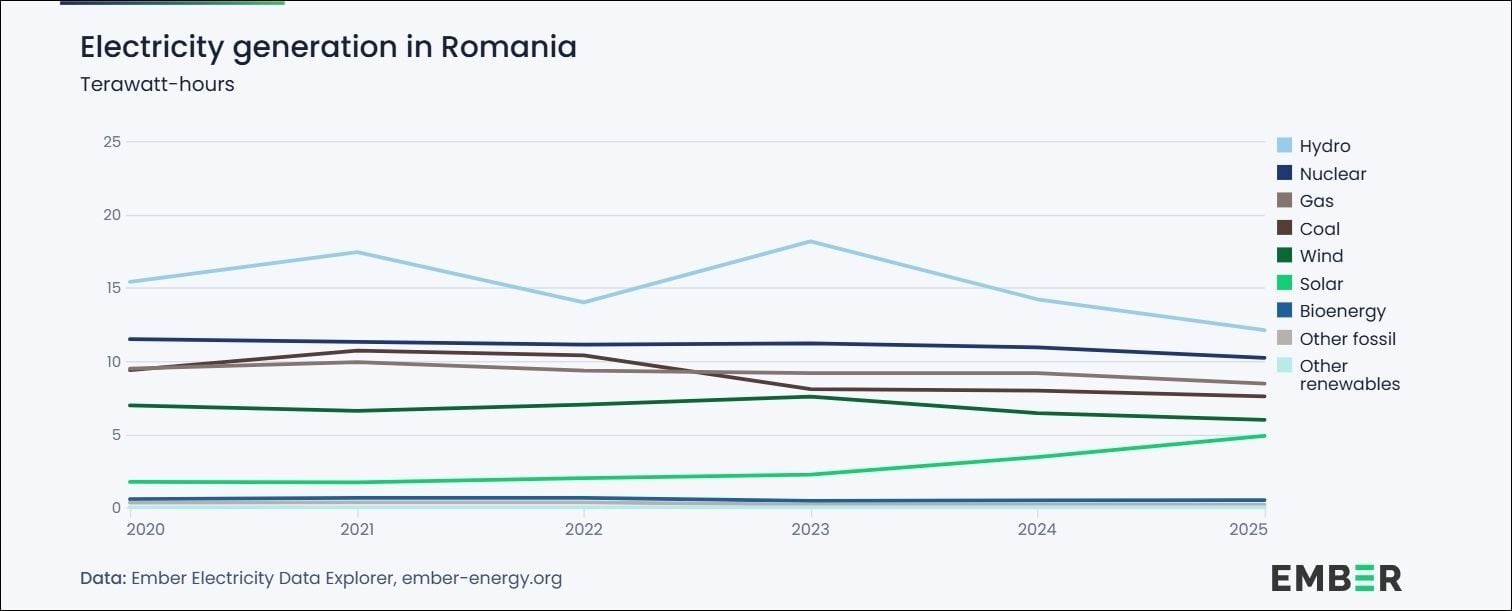 Source: Ember
BESS buildout in Romania
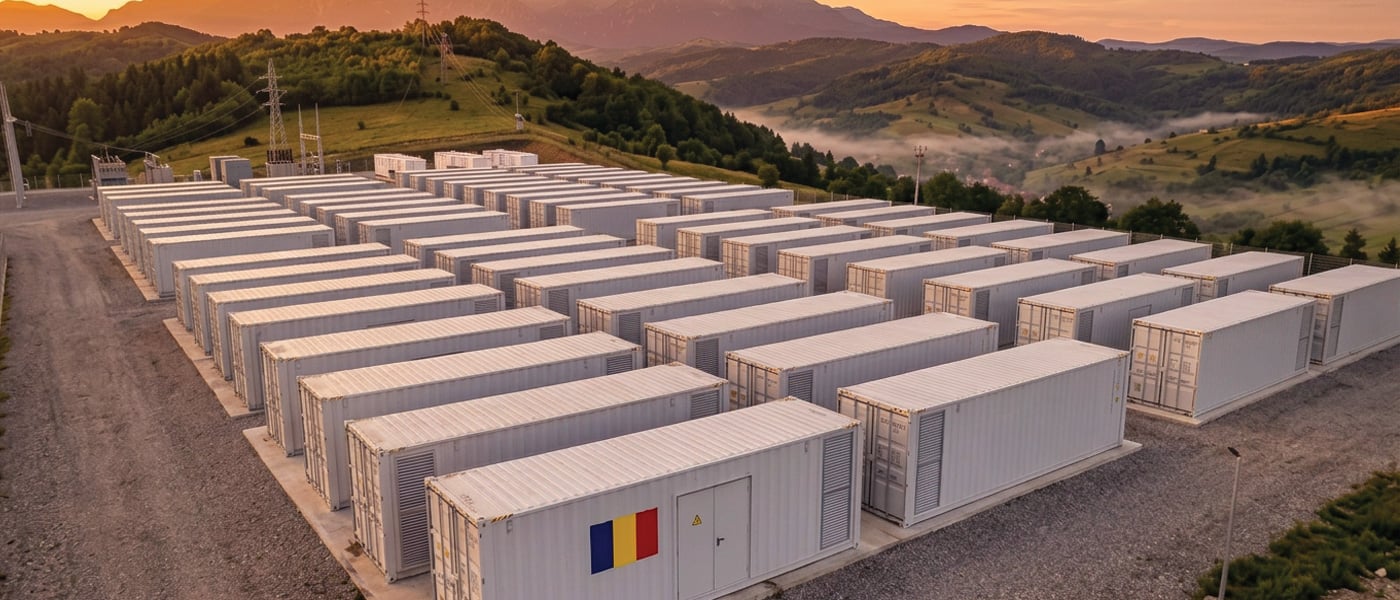
The Romanian BESS market is expanding rapidly, backed by the growing renewable penetration and strong policy support. Romania’s energy ministry approved a €150 million funding scheme for standalone batteries, which aims to support at least 2.2 GWh of new storage capacity, while earlier funding rounds also supported co-located projects. Romania is still in the early stages of development, but asset owners can use this to their advantage. At the start of 2025, Romania had around 137 MW of installed BESS capacity, with a rise to roughly 493 MW expected by the end of the year. The pipeline is much larger – above 12 GW – but only part of it has secured technical connection approvals, known as ATRs (Aviz Tehnic de Racordare), and construction permits, so the opportunity should be framed as large but still developing.
Romania's grid and interconnections with other countries
Romania’s transmission network, operated by Transelectrica, spans almost 9,000 km of high-voltage lines, and congestion is typically more moderate than in other European grids. However, the buildout of renewables and storage projects creates bottlenecks and makes grid connection requests more competitive.
Romania occupies a strategic position within the South-East European power market, with interconnections to Hungary, Serbia, Ukraine, Bulgaria, and Moldova through a high-voltage transmission network. These cross-border links facilitate participation in integrated electricity markets, enable power trading via OPCOM (the Romanian electricity and gas market operator) and neighboring exchanges, and support regional price convergence through market coupling mechanisms. The grid-connection reform is very relevant for BESS developers and ongoing grid enhancement projects, particularly on the Hungary-Romania corridor, are expected to improve exports and strengthen Romania’s role as a regional hub for the deployment of RES (renewable energy sources) and BESS.
How the power market works in Romania
The Romanian power market structure comprises several segments:
- Wholesale market
- Ancillary services
- Balancing/imbalance market (PE)
Romania's wholesale market
Romania’s power market liquidity is strengthening, with day-ahead market volumes increasing from 19.7 TWh in 2024 to 23.1 TWh in 2025 (+17%) following the removal of the national centralized energy acquisition mechanism (MACEE). Intraday market volumes grew from 2.5 TWh to 4.6 TWh (+84%), driven by increasing RES penetration, the launch of BRM’s Nord Pool-operated platform, and growing algorithmic trading activity. Together with ~45.9 TWh traded via bilateral contracts, this provides a deep and increasingly liquid market environment for BESS optimization and flexibility trading.
The Romanian wholesale market offers three main revenue streams:
- Day-ahead auction (Piața pentru Ziua Următoare - PZU)
- Intraday auction (Piața Intrazilnică - PI)
- Intraday continuous trading (Piața Intrazilnică Continuă - PIC)
Overview wholesale market Romania
| DA (PZU) | ID 1 (PI 1) | ID 2 (PI 2) | ID 3 (PI 3) | IDC (PIC) | |
| Market type | Daily auction | Daily auction | Daily auction | Daily auction | Continuous trading |
| Remuneration | Pay-as-cleared | Pay-as-cleared | Pay-as-cleared | Pay-as-cleared | Pay-as-bid |
| Session opening |
06:00 CET (D-1) |
11:00 CET (D-1) | 16:00 CET (D-1) | 23:00 CET (D-1) | After DA results are published |
| Gate closure |
12:00 CET (D-1) |
15:00 CET (D-1) | 22:00 CET (D-1) | 10:00 CET (D) | 1 hour before delivery |
| Product type |
15-minute, hourly, and block products; base load (24h) and peak load (12h) |
Hourly and quarter-hourly blocks | Hourly and quarter-hourly blocks | Hourly and quarter-hourly blocks |
Hourly and quarter-hourly blocks |
Romania’s wholesale electricity market is integrated with European power markets via the SDAC and SIDC frameworks. The DA market participates in SDAC, enabling implicit cross-border capacity allocation and price coupling with neighboring countries. On the intraday side, Romania participates in both the SIDC intraday auctions (1-3) and intraday continuous trading, allowing market players to optimize positions closer to real time while benefiting from increased liquidity and cross-border trading.
Ancillary services in Romania
Reserve markets are a key potential revenue stream for battery systems in Romania. The market is operated by Transelectrica and increasingly harmonized with European balancing platforms. Ancillary services in Romania include:
- Primary reserve: FCR (Frequency Containment Reserve)
- Secondary reserve: aFRR (automatic Frequency Restoration Reserve)
- Tertiary reserve: mFRR (manual Frequency Restoration Reserve)
aFRR and mFRR are established and technically accessible to batteries, subject to prequalification and delivery constraints, while FCR is still in a transition phase, with BESS participation expected once the prequalification framework becomes fully operational.
Overview ancillary services Romania
| FCR | aFRR | mFRR | |
| Market status | Transitioning phase | Established | Established |
| Procurement | Daily tender organized by Transelectrica | Daily tender organized by Transelectrica | Daily tender organized by Transelectrica |
| Activation requirement | Must reach full volume within 30 sec post-activation | Automatically activated within 5 min | Manually activated; must be fully delivered within 12.5 min |
| Pan-European cooperation | Not currently planned | PICASSO (non-operational member; go-live planned in 2026) | MARI (non-operational member; go-live planned in 2026) |
| Payment | Capacity: pay-as-bid |
Capacity: pay-as-bid Energy: pay-as-cleared |
Payments for reserved mFRR capacity and activated balancing energy |
Correcting imbalances in Romania
Romania's balancing market (Piața de Echilibrare, PE), operated by Transelectrica, sometimes referred to as imbalance market, serves to settle imbalances between scheduled and actual electricity generation or consumption. After the closure of the day-ahead and intraday markets, Balancing Responsible Parties (BRPs) are financially exposed to deviations from their nominated schedules and actual generation or consumption. Balancing Service Providers (BSPs), by contrast, provide balancing capacity and/or balancing energy to Transelectrica.
Under the EU's harmonized single-price imbalance settlement framework, market participants may benefit financially when their imbalance supports the system's balancing needs and are penalized when their imbalance aggravates the system imbalance, creating incentives for accurate forecasting without restricting value capture from beneficial flexibility.
Romania currently operates as a single bidding zone, meaning that market transactions settle at a uniform national price. While internal grid congestion exists, particularly in high-renewable regions, it is managed through operational measures, redispatch/network planning, and grid reinforcement rather than through locational price signals, zonal pricing, LMP, or a dedicated standalone congestion-management market.
Outlook for BESS in Romania
Romania is becoming an increasingly attractive market for battery storage as renewable deployment accelerates and the need for flexibility grows. Rising solar and wind penetration, combined with grid congestion challenges and the gradual transition away from coal generation, are creating favorable conditions for BESS participation across wholesale, balancing, and ancillary service markets. With storage deployment still relatively limited, early market entrants can benefit from strong positioning in a developing flexibility landscape.
Romania does not currently operate a formal capacity remuneration mechanism for generation adequacy. However, BESS can access merchant revenues and, where prequalified, balancing capacity and energy payments in reserve markets. This makes cross-market optimization across DA, ID, aFRR/mFRR, and, once available, FCR particularly important. This makes sophisticated cross-market optimization essential for maximizing returns across the previously mentioned markets. Increasing market volatility and renewable intermittency are expected to further strengthen the value proposition for well-optimized battery assets in the coming years. Regulations for BESS market participation are currently under development, so access to ancillary services might be limited at the time of writing in 2026.
Clean Horizon's storage index suggests that Romanian BESS revenue potential has strengthened since mid-2024, but it should be presented as an indicative market signal rather than an asset-specific revenue forecast.
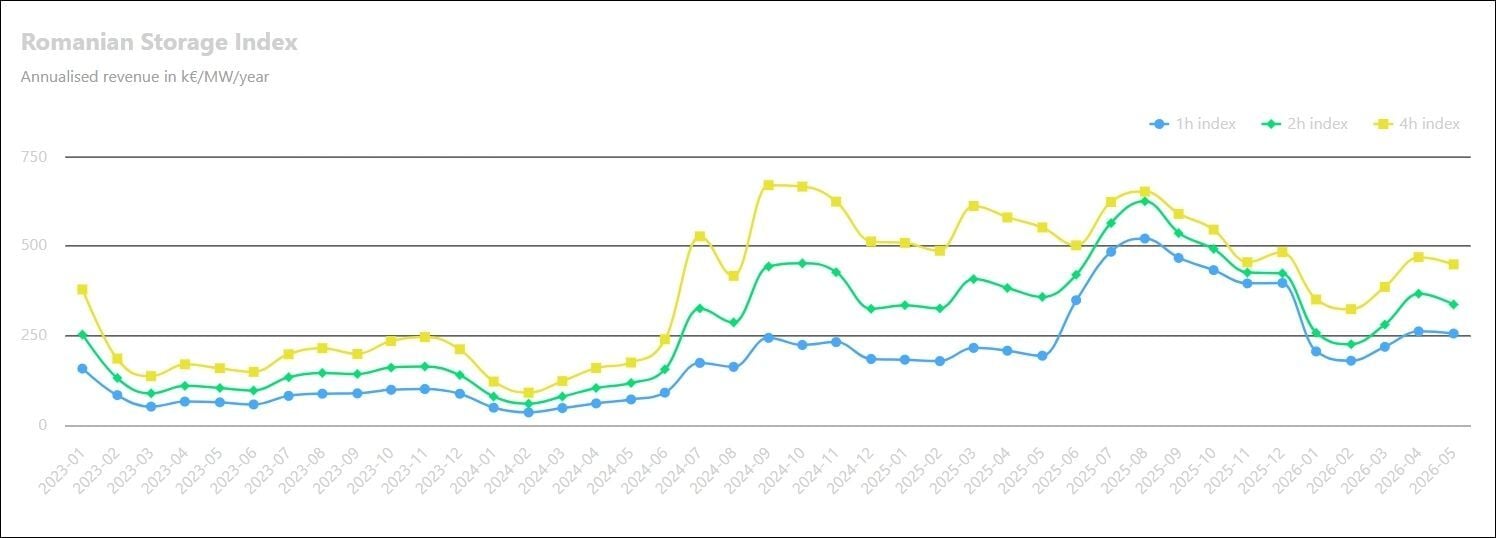 Source: Clean Horizon
Sources:
Ember
ANRE
Energy Industry Review
Ebattery Energy
Energynomics
OPCOM
Transelectrica
AFRY