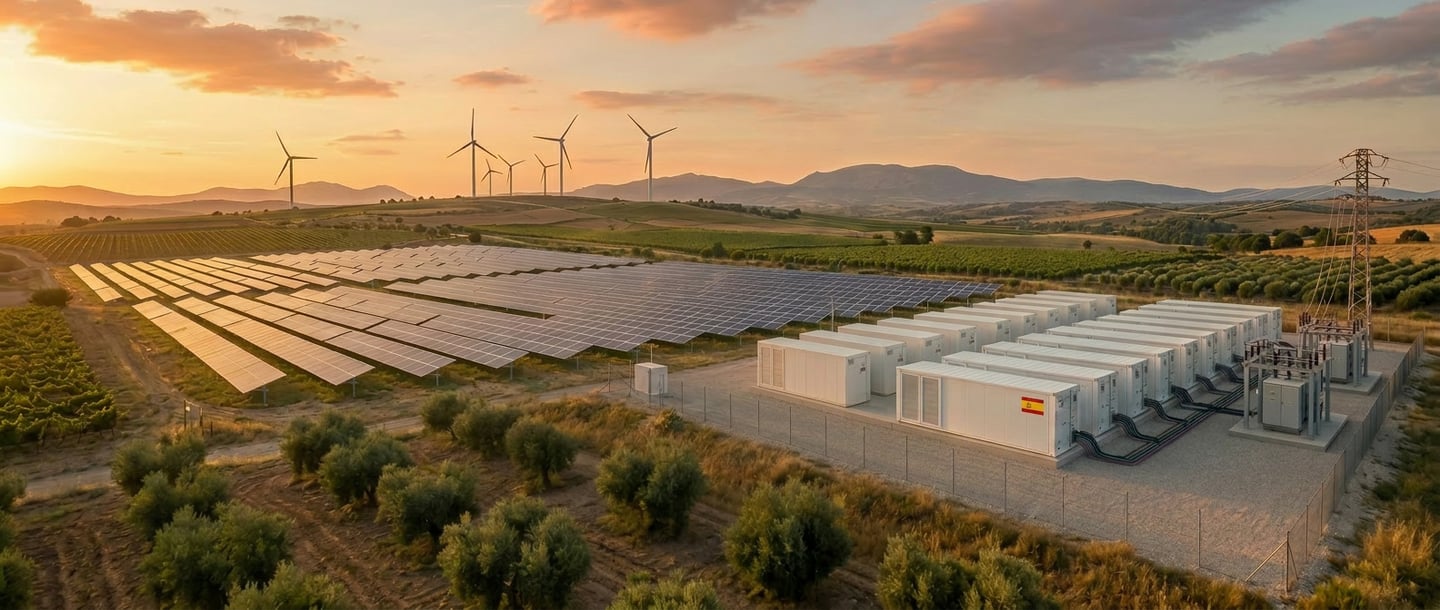
Co-location in Spain
The high renewable penetration in Spain led to solar cannibalization, with price effects so significant that they are unable to sustain standalone PV in the long run. Therefore, today, PV projects in Spain are increasingly difficult to develop without associated storage. Likewise, most owners of existing solar parks are already assessing the possibility of adding storage to their assets. This brings several challenges in connection with commercial optimization and project financing.
Financing institutions are familiar with standalone renewable assets – their operational workings, bankability, revenue expectations, and associated risks. Battery energy storage systems (BESS), especially in co-located setups, are considerably more complex in their operational deployment, market participation, risk assessment, and even contractual structuring. Although lenders are becoming more acquainted with storage technology, open questions remain about revenue stability, battery degradation, and real-world optimization results, especially in a new market environment.
A key concern for both asset owners and lenders in co-located setups is ensuring that route-to-market providers don’t favor the dispatch of one asset over the other to further their own commercial interests. In this regard, enspired’s optimization provides reassurance, as it’s designed to maximize the combined market value of both assets. The renewable plant and the battery are treated as one integrated system. To avoid any ambiguity, the commercial structures proposed for co-location by Nexus Energía and enspired follow this principle, ensuring that incentives remain fully aligned with the overall performance of the project.
A related concern is whether a single battery or co-located asset within a broader portfolio can truly be optimized in the best possible way, rather than compete with other assets in the same portfolio. Both banks and asset owners need assurance that their battery won’t benefit other systems in the portfolio or be put at a disadvantage by them. From an operational perspective, this is a non-issue since every asset is traded and optimized in isolation, independent of the optimizer’s portfolio at large. There is no competition between assets at any time, even if they’re optimized by the same route-to-market provider. The only market in Spain that requires aggregated participation is aFRR (secondary regulation). Even in that case, the opportunity cost of each asset is assessed individually when designing bids for REE (Red Eléctrica de España) and allocating potential activations across the different assets.
Revenue planning and financing with BESS in the Spanish market
Spain is an emerging storage market, and the availability of performance track records for BESS is therefore much more limited than in a mature market like Germany. Since revenue simulations and backtests tend to reflect an incomplete picture of the commercial reality, and the lack of live reference assets or revenue benchmarks amplifies lender uncertainty, BESS projects, both standalone and co-located, generally require contracted revenues to qualify for financing. Purely merchant structures are rare, but in some cases, large independent power producers (IPPs) can finance batteries within broader renewable portfolios using contracted revenues from the renewable energy source (RES) to support the BESS investment.
Contracted revenues are fairly straightforward for a standalone battery (one asset, one connection point, clear revenue attribution), but co-location adds another level of complexity to financing. In a hybrid setup, project owners must decide how to structure revenues across and between the renewable asset and the battery. Depending on applicable Purchase Power Agreements (PPAs), they could contract both assets together, contract only the RES and operate the battery merchant, or contract only the BESS and operate the renewable merchant. Additional complexity arises when a battery is added to an already operational RES, as existing PPAs can contain restrictions that impair battery optimizability, asset dispatch, and the project’s revenue structure. In co-location, financial decision-makers must evaluate multiple interacting operational, commercial, and risk-management scenarios simultaneously.
Get financing structures and revenue simulations for Spain →
Financing and asset configuration are largely up to project developers and lenders, but regulatory interference with marketization is optimizer territory. A BESS participating in ancillary services must be balanced at all times. In co-location, this obligation extends to the entire site, and since renewables are inherently imbalanced, careful management of the project’s imbalance risk becomes a key component of the optimization strategy. In practice, this often means deliberately underselling expected renewable generation to avoid penalties. Forecasting accuracy is paramount for achieving strong commercial results while ensuring compliance, but contingencies must still be accounted for by the optimizer.
One such eventuality is curtailment. If the grid operator unexpectedly reduces your scheduled injection, and you’re suddenly left with a surplus of renewable capacity, the power flow can be redirected into the BESS. The opportunity cost to charge the BESS is effectively zero, but the ability to capture this value again relies on accurate forecasting and fast, automated optimization models that can respond to deviations in real time.
Securing a strategic edge with AI
This is where artificial intelligence (AI) becomes a decisive tool. In addition to power prices, renewable production and weather forecasting are also highly relevant when optimizing co-location. AI enables the simultaneous evaluation of billions of market, price, weather, and production scenarios, as well as the optimization of the battery and the renewable asset as an integrated system rather than separate entities. This approach unlocks the full monetary potential of co-location and ensures that both assets support rather than compete with each other.
The value of advanced optimization is already becoming visible in Spain. At enspired, we simulate the revenues that different battery configurations could have generated in the Spanish intraday continuous market, and the results are quite promising. The key challenge now lies in realizing this potential, as projected gains won’t materialize without a data-driven, AI-integrated optimization strategy backed by a proven track record in more mature markets. Optimization isn’t a cost item in BESS operation; it’s real income earned in real markets. And those are fast, messy, and full of constraints. Asset owners supported by advanced optimization capabilities will be best positioned to capture the significant revenue potential of BESS and maintain a competitive advantage as the Spanish market continues to evolve.
More about enspired in Spain.
Financing structures and revenue simulations for Spain
To succeed with your battery project in Spain, you need a financing structure backed by guaranteed, bankable revenues. Which structures are available, and what revenues can be expected for different BESS configurations? Sign up to get the details and numbers in your inbox.