What are non-frequency ancillary services?
Unlike ancillary services (FCR, aFRR, mFRR), non-frequency ancillary services aren’t procured solely for frequency control or real-time balancing purposes but also to perform support functions and address contingencies such as voltage stability, resistance to disturbances, and system recovery.
The backstory
The European grid was historically built around electricity generation from rotating units, such as coal, gas-fired, and nuclear power plants. Rotating masses provide inertia, a form of kinetic energy that stabilizes frequency disturbances within seconds or even milliseconds. Conventional power plants also supply short-circuit power as a byproduct, offer reactive power at low prices, and serve as a point of contact for black start capability, usually through bilateral arrangements.
Because of the energy transition, the deployment of inverter-based generation, found in renewables and battery storage, is increasing, while rotating units are being phased out. Impedances are evolving as cables continue to replace overhead lines.
To accommodate these developments, the EU adopted an approach that recognizes grid-sustaining properties and byproducts as services to the system and subjects them to market-based allocation. This improves transparency and combats technology-based discrimination, rendering bilateral agreements and associated processes largely redundant.
The legal framework and situation in Germany
Article 40 of Directive (EU) 2019/944, part of the Clean Energy Package, requires EU member states to implement a market-based procurement of non-frequency ancillary services where possible. In line with a mandate enacted by Article 12h EnWG in 2020, Germany introduced procurement concepts for three non-frequency ancillary services, also known as grid stability services, which could become sources for contract-based revenue generation with BESS (battery energy storage systems):
- Inertia (BK6-23-010)
- Reactive power (BK6-23-072)
- Black start capability (BK6-21-023)
1. Inertia (Momentanreserve)
Provided in megawatt-seconds (MWs), inertia is a power asset’s ability to react instantly to changes in grid frequency and restore balance within seconds. It used to be provided by rotating masses as an inherent byproduct.
As the energy transition progresses and inverter-based injection units continue to replace fossil power plants, fewer rotating masses get connected to the grid. Since the system still relies on inertia, alternatives must be found. Batteries can act as a source of inertia, and inverters can provide it if grid-forming characteristics are considered in the asset design. From a physical standpoint, the level of inertia depends on the weight and size of the rotating masses; larger rotating masses provide a greater amount of inertia. Inverters can simulate this effect.
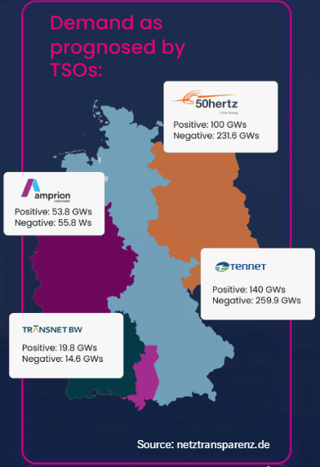 Inertia demand prognoses by the German TSOs for their respective regions
Graph based on data from netztransparenz.de
Procurement of inertia
The inertia procurement concept targets a tender-like approach with fixed prices for the delivery duration and technology-based products. The delivery period is to be set by the provider between 24 and 120 months. All valid offers will be awarded, as demand for this product is expected to exceed supply.
For bids submitted until the end of 2027, the currently defined fixed price applies for the entire delivery period (e.g., 10 years), regardless of project lead times. For bids from 2028 onwards, a new, yet-to-be determined fixed price will apply.
Inertia data is provided via API, including monthly availability per technical unit and yearly settlement. On request, minute-level data, such as battery SoC (State of Charge), and the ramp-up time constant must be made available.
Inertia availability and remuneration
A quarter-hour is considered available for inertia if the asset’s average output remains below its maximum capacity (Pmax) minus a defined margin, meaning when the BESS isn’t fully charged. This ensures the asset has sufficient headroom and controllability to respond to frequency changes and can effectively provide and be remunerated for inertia.
Inertia is structured as two availability-based products:
- Premium product with high availability requirements and higher remuneration
- Base product with lower availability thresholds and lower revenues
Payments scale with achieved availability, but if availability falls below the minimum requirement, no payment is issued. For batteries, inertia is interesting if overload (overshoot) capacity applies, as it allows assets to provide additional power beyond nominal capacity without impacting regular operations or causing thermal stress. This enables high availability independent of other market activities, making inertia, especially the premium product, a largely incremental revenue stream. The achievable revenue level with inertia provision depends on various factors and would require asset-specific calculations.
How does inertia interact with the wholesale market?
The required energy reservoir for inertia provision is minimal. With overshoot capacity (the inverter’s ability to temporarily exceed its operational power setpoint – e.g., +20%), inertia is deliverable in addition to trading positions and won’t interfere with wholesale or balancing activities. Without overshoot capacity, inertia provision is still possible but can only be provided via the base product. Availability becomes the key factor in determining remuneration.
2. Reactive power (Blindleistung)
What is reactive power? Measured in MVar, reactive power (Q) is the non-working electrical power that regulates the magnetic fields in alternating current (AC) systems and helps the grid maintain its required voltage level. Unlike frequency, which behaves globally, voltage levels are local. This means a drop or surge in voltage levels in Germany can’t be mitigated by reactive power injections or withdrawals in Spain. Reactive power has two directions: capacitive (feed-in) and inductive (absorption). Since batteries deliver only direct current (DC), they use an inverter to convert it to alternating current.
Concept for the procurement of reactive power
TSOs procure reactive power through regional auctions that take place sequentially according to calendar timing. Four different products are available, with one chosen per tender. Remuneration depends on the product: Unsecured products are paid per reactive energy, while secured products are paid for availability. Some combine capacity and energy payments via a usage surcharge. The auctions follow a pay-as-bid model and may include price caps.
Assets must comply with TSO connection requirements (50Hertz, TenneT, TransnetBW, Amprion) and provide various technical specifications, including a P-Q diagram, metering, setpoint control, and defined fallback behavior if communication fails. Proof of readiness is required for projects under construction.
Planned outages must be coordinated in advance and unplanned outages reported immediately. Any outage counts as a full day of unavailability, with one unpaid day of unavailability allowed per month. Non-compliance triggers penalties (up to double the daily availability price, capped at twice the remuneration entitlement).
Reactive power timeline:
- Tender announcement (according to calendar timing)
- Bilateral contact with TSO and access to procurement portal
- Submission of offer including sample contract and technical description
- Award allocation
- Product delivery
3. Black start (Schwarzstart)
Black start is a power asset’s ability to restart the grid without external electricity and operate in island mode after a blackout (total loss of power) or brownout (partial, temporary, and, in some cases, controlled reduction of power and voltage). Grid recovery requires specialized equipment and follows strict protocols. Due to this complexity, black start services are procured in phases and less standardized than other non-frequency ancillary services.
Black start product and procurement concept
TSOs procure the availability of black start capacity from BESS via regional, sequential auctions, each with specific technical requirements. The agreed capacity reserve must be available in case of a blackout. The product duration is 10 years, and awards are based on a point system:
- Technical asset criteria (up to 30 points)
- Systemic value (up to 30 points)
- Price (up to 40 points)
Black start remuneration
Remuneration for black start follows a pay-as-bid structure, with prices including transparent opportunity costs that are indexed over time based on market spreads (calculated and capped by the TSO). Primary energy for testing purposes is reimbursed separately on a cost basis. If availability drops, compensation decreases, and penalties increase. Additional penalties apply if the required energy reservoir isn’t maintained.
Non-frequency ancillary services as new revenue streams for BESS
Non-frequency ancillary services, specifically inertia, reactive power, and black start, offer attractive new revenue streams to capture with BESS. They can enhance and further diversify existing cross-market optimization strategies. At the same time, these services offer valuable system benefits, improving grid stability, voltage control, and network resilience in increasingly renewable-driven power networks.