The priority question in the optimization of grey co-location
As grey co-location gains traction in Germany as an accelerator of BESS (battery energy storage system) grid access and an economically beneficial setup for the grid operator, the question arises of how this co-located setup, where grid access for the battery is variably restricted by the RES (renewable energy source) production, can be optimized in the market.
In a strict PV-priority setup, the PV cannot be curtailed, and the battery is forced to operate around the grid limit. Differences between forecast and actual production cause variable grid restrictions for BESS, making it challenging to participate in ancillary service markets, where the capacity to deliver energy needs to be guaranteed a day in advance. This substantially reduces achievable PnL (profit and loss). In a BESS-priority setup, the PV can always be curtailed, and the optimization of the battery takes priority, but this approach entails lost PV revenues and mirrors a standalone BESS case.
Commercially, the superior solution is a form of joint optimization, where a reduction of PV generation is applied only if the battery’s market earnings clearly exceed the value of PV generation, i.e., can offset the cost of reducing production. In this case, the solution is not to determine the best scenario for a BESS in a primary or secondary role, but to pursue the commercial optimum of the entire site. Market signals are typically inverted enough for BESS and PV to co-exist profitably on the same connection point. This means the value of the business case is maximized by optimizing the battery’s trading activities and the PV’s production profile.
Dispatch profiles, capacity allocation, bidding
In BESS optimization, the battery is optimized continuously throughout the day and can participate in DA (day-ahead) and IDA (intraday) auctions, ancillary services (AS), and intraday continuous trading for revenue stacking. The required data input for co-location includes the PV production profile, as well as the battery’s real-time SoC (state of charge), general system configurations (grid access, power, capacity), and warranty terms. From those specifications, the trading model deduces optimized bids and a dispatch schedule for the battery, as well as signals for when and how to reduce PV production.
This can be illustrated with a conservative example of a standard case commonly seen in Germany – a 1:1:1 setup, where a 10 MW grid access point has connections to:
A) PV with a 10 MW peak and an existing PPA paying 42€/MWh, with the possibility of reducing production
B) BESS with 10 MW/20 MWh and 2 cycles per day
The optimization snapshots below, dated 14 June 2025, display a rich PV curve and typical price conditions for summer, including a significant aFRR down capacity price spike. These trends are reflected in the optimization profile. The individual steps are shown in Figure 1, Plots 1-6, followed by a commentary on the optimization activities.
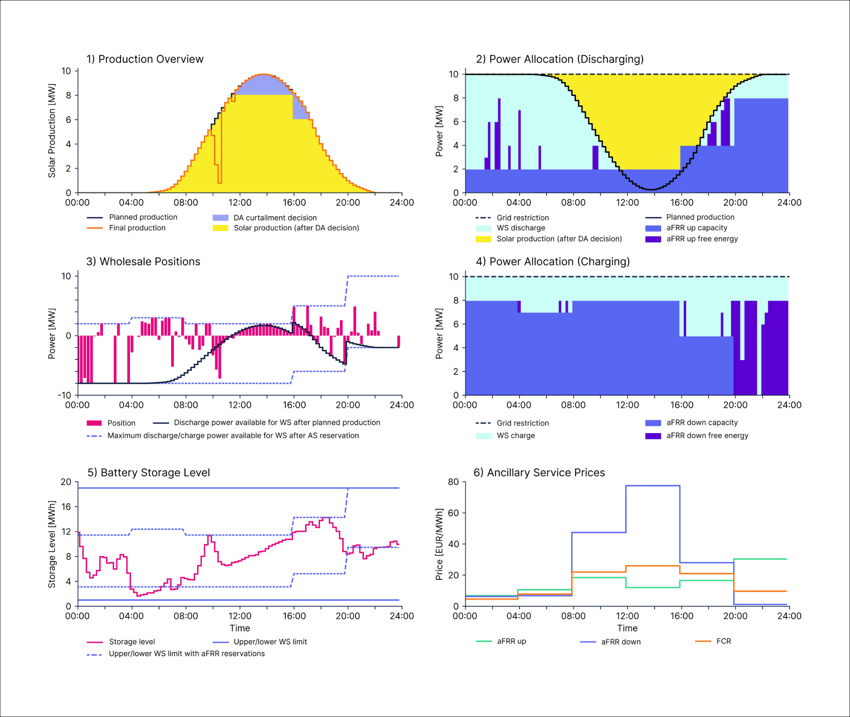 Figure 1, Plots 1-6: Optimization schedule of PV and BESS co-location setup
- BESS optimization
Large volumes are traded in aFRR down throughout the day (Plot 1.4), as this direction is not limited by the PV production. Small volumes are placed into aFRR up throughout the day, with larger volumes committed in the evening due to favorable prices (Plot 1.6) and the absence of grid restrictions from the PV (Plot 1.2). There is no participation in FCR due to limited additional revenue potential. - PV production profile optimization
The day-ahead decision (in the ancillary service auction) to reduce the PV production enables the leveraging of aFRR up capacity, meaning the revenue loss from the opportunity cost payment is compensated by the battery’s aFRR up earnings. - Final dispatch
aFRR energy activations (not shown) and anticipated charging from RES require SoC management, including a reduction in PV production (Plot 1.1, orange line; Plot 1.3 sell positions ignore the discharge restriction from the planned production between 10:00-11:00 and at 11:45). The wholesale (WS) positions within the remaining limits capture price spreads (not shown) throughout the day. An adjustment on the day-ahead curtailment decision is made: Instead of reducing PV production to accommodate aFRR up capacity commitments (while financially sound), it can be more profitable not to adjust production and buy the positions back in the market instead, effectively charging the BESS with “excess” energy (Plot 1.1, blue segment; Plot 1.3, wholesale positions adhere to the PV’s afternoon discharge power restriction). From a grid perspective, curtailment versus charging the battery from the PV is a neutral operation.
Battery sizing and revenue scenarios
Battery sizing is a common pain point in co-location. For a 10 MW PV, backtests were compared for a variety of battery sizes, ranging from 5-10 MW and 1-3 hours, that are either standalone or co-located, between July 2024 and July 2025. Findings show that the restrictions imposed by the co-located PV have only a minor impact on the earning potential of the BESS. Generally speaking, the revenue reduction depends strongly on curtailment costs and how these relate to ancillary services and market prices. In the example and assuming perfect foresight, the revenue reduction for fully integrated hybrid systems is less than 3.5%. For smaller assets, the impact is even less pronounced. Even assuming forecast deviations, the revenue reduction for co-location is around the 4% mark, with smaller assets again less affected.
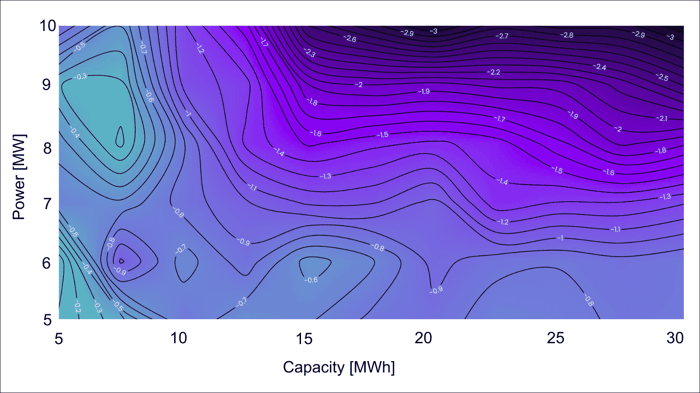 Figure 2: Revenue deviations between standalone and co-located BESS in %
Reference setup: 10 MW grid access, 10 MWp PV production
PPA models and opportunity costs
As PPA prices are no longer sufficient to finance RES, an alternative strategy is needed to make renewables economically viable in the future. Co-location with BESS unlocks additional opportunities for revenue capture, and the PV owner’s earnings will not suffer from a co located setup if opportunity costs for curtailment are managed correctly. While a range of different PPAs can be modelled in the optimization, structures that support free BESS marketing offer the highest upside potential. The two examples below illustrate how PPAs can impact revenue.
Option A: Profile PPA
In a profile PPA, the delivery profile is fixed (e.g., 6 MW from 8:00-20:00), and the battery can shift the PV production to deliver this profile. In this scenario, the PPA price is higher (e.g., 72€/MWh instead of 42€/MWh), but the battery has limited optimization potential.
Option B: Pay-as-produced PPA and free BESS optimization
In this setup, the PV sells power at fixed price (e.g., 42€/MWh) and can be curtailed, while the battery is optimized across all markets (AS, WS). The PV curtailment creates opportunity costs. Opportunity costs refer to the internal “costs” of unproduced MWhs. In this example, this cost equates to the 42€/MWh the PV would have earned, as well as any other costs the PV owner incurs due to non-production. The battery takes priority over the PV production only if opportunity costs are offset by revenues or if corrections are necessary to avoid constraint violations.
The commercial case for fully integrated co-location
Making grey co-location viable as a business case requires flexibility from both assets. Even in a PV-priority setup, a certain degree of control over the solar production should be negotiated to increase BESS profitability through participation in ancillary services, which is vital for revenue stacking. In co-location, the ideal strategy consciously refrains from approaching the optimization as a matter of which asset has priority over the other and instead considers the costs for different operations, leveraging additional opportunities that arise from treating both assets as a unit with hybrid flexibility. The outcome is what is referred to as the commercial optimum or, in simpler words, maximum revenue.
Disclaimer: Due to the dynamic nature of algorithmic trading, the optimization strategy presented here is subject to change and further improvements.
All you need to know about co-location in 2026
This white paper, cowritten by 8Energies, enspired, and Goldbeck Solar, presents a detailed concept for asset managers, IPPs, and grid operators, showing how grey battery storage can be implemented as a co-located setup at existing and newly built PV facilities.