Updated: February 2026
This article examines the structure of the Dutch energy market, focusing on renewables and BESS (battery energy storage systems). It identifies opportunities and challenges in battery monetization and decarbonization, drawing on exclusive insights from local asset developer S4 Energy.
The Dutch energy mix
Like many other countries, the Netherlands aims to achieve net-zero emissions by 2050. In the first half of 2025, renewables made up 48% of domestic energy production, down 1 billion kWh from the previous year. While wind, both onshore and offshore, accounted for the majority of renewable production in 2024, solar surpassed the combined wind output by close to a third in 2025. Conventional power plants are marginally ahead of renewables in electricity production, with natural gas supplying the most, followed by coal.
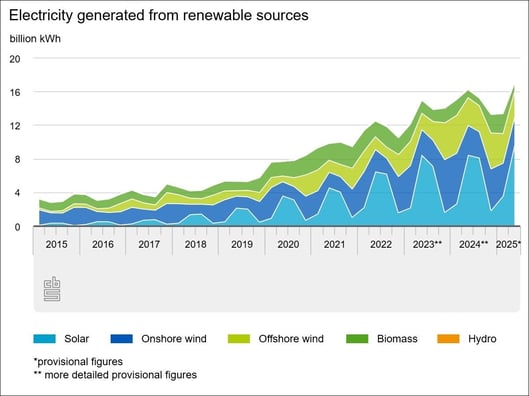 Source: CBS Statistics Netherlands
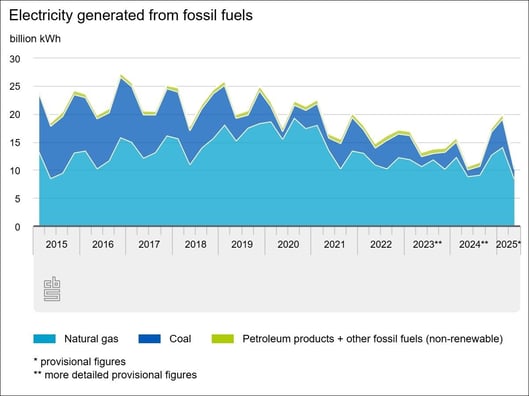 Source: CBS Statistics Netherlands
The domestic total energy supply paints a different picture, with oil and natural gas still making up the majority of the mix in 2024 – a combined 76%, down 1% from 2023. While a portion of this share is used directly (e.g., industrial heat), most of it gets converted into electricity or fuels for end consumers.
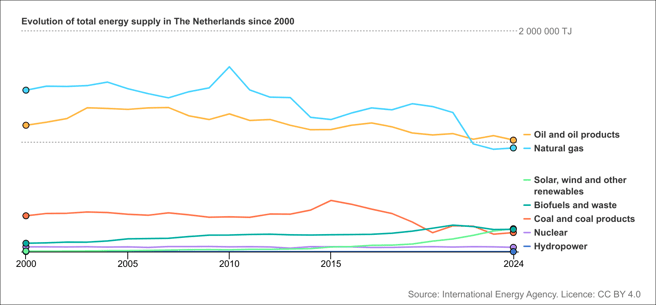 Source: IEA
How does battery storage capacity measure up?
BESS in the Netherlands is a relatively new but increasingly necessary industry. A striking growth in battery capacity began in 2021 when the total installed capacity rose by 65% compared to the previous year. This number doubled in 2022 and then tripled in 2023, reaching 621 MWh. A development observed in 2025 is the increase in large-scale storage projects.
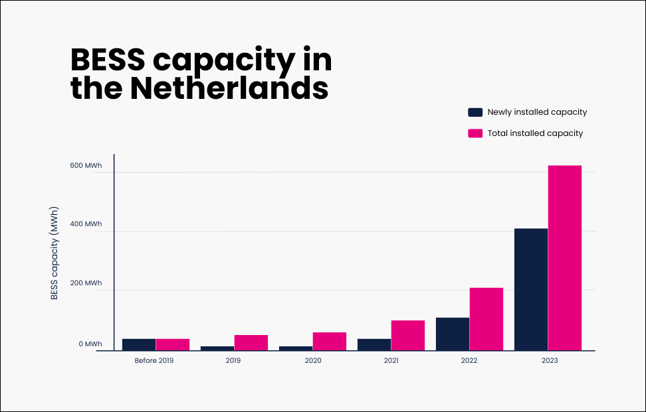 Source: Graph by enspired based on DNE Research National Smart Storage Trend Report 24/25
To address the need for more storage driven by the rapid renewable buildout, Dutch grid operators developed mid (KA), high (ND), and low (IA) deployment scenarios for the further rollout of BESS technology. Specifically for grid-scale and co-located solar, these range from 5.2 GW to 12.7 GW by 2030 and from 8 GW to 19.5 GW by 2035. In theory, this sounds promising, but the Netherlands faces a complex challenge on this trajectory that is more pronounced than in other European countries: grid congestion.
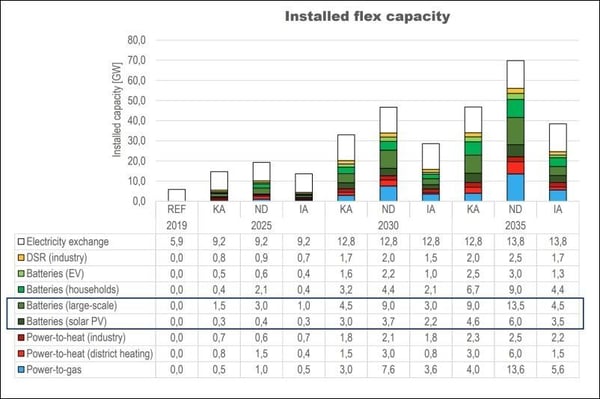 Source: Graph by TenneT based on Netbeheer Nederland Scenario Investment Plans 2024
Support for flexible assets that can help counter this problem comes from the TSO (Transmission System Operator) directly. In a recent move to ease grid congestion, TenneT has decided to allocate 9 GW via off-peak capacity contracts, incentivizing heavy energy consumers to shift their usage to times of low demand. This means that selected batteries can be connected to the grid more easily. So far, more than 70 GW, mainly from large-scale battery parks, have applied for the new contracts, which far exceeds the available capacity.
The Dutch power grid
The Dutch electricity sector is governed by legal frameworks defining various key roles and responsibilities. These include generators, consumers, and suppliers as well as TSOs and DSOs (Distribution System Operators). Additionally, BRPs (Balancing Responsible Parties), BSPs (Balancing Service Providers), and CSPs (Congestion Service Providers) contribute vital functions that allow the grid to stay in balance and respond to irregularities.
As the national TSO, TenneT manages the Netherlands’ interconnectors to other countries, monitors the balance between supply and demand, and coordinates the adjustment of electricity offtake and feed-in with responsible parties. In short, TenneT is in charge of keeping the domestic high-voltage grid at a stable frequency of 50 Hertz at all times.
The Netherlands is one of the most densely populated countries in the world and exhibits a relatively strong concentration of decentralized energy sources across its land area. Due to a high electricity demand for home-charged EVs (electric vehicles), air conditioning, and heat pumps, PV (photovoltaic) roof installations continue to gain traction – 2.55 GW of residential solar capacity was added in 2023 alone. The local grid is struggling to accommodate the heavy influx of renewables, and ensuing congestion issues are causing problems for the Dutch society at large. (Source: Netherlands Experiencing Sustainable Solar PV Growth, Says IEA PVPS) As energy-intensive industries and other players, including households, encounter long waiting lists for new grid connections, they are also faced with the prospect of rising electricity and feed-in costs.
Ongoing grid congestion makes it difficult to scale up renewable production at the pace needed to reach climate targets. Batteries, both BTM and grid-scale FTM (front-of-the-meter), play an important role in mitigating such challenges and offer a sustainable solution to future-proof the Netherlands’ electricity system. But how can it integrate more batteries if the grid struggles to handle the current load? As a provider of flexibility, BESS helps prevent and resolve grid congestion, but a high concentration of batteries could also pose new challenges for grid management if not properly coordinated with renewable injections. Addressing this risk, the Dutch market joined PICASSO in October 2024 to leverage the balancing capacity of neighboring markets.
* Platform for the International Coordination of Automated Frequency Restoration and Stable System Operation
BESS revenue streams in the Netherlands
 Source: TenneT
 Source: Rabobank
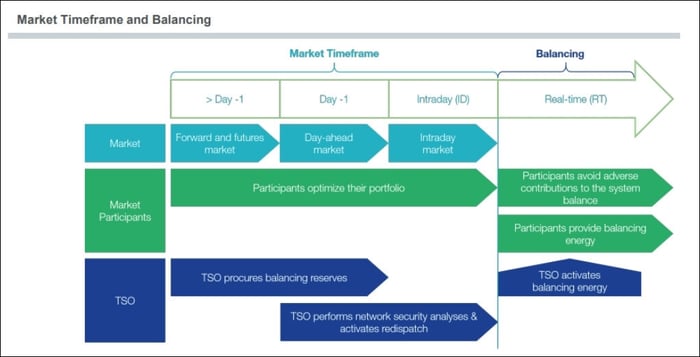
Wholesales
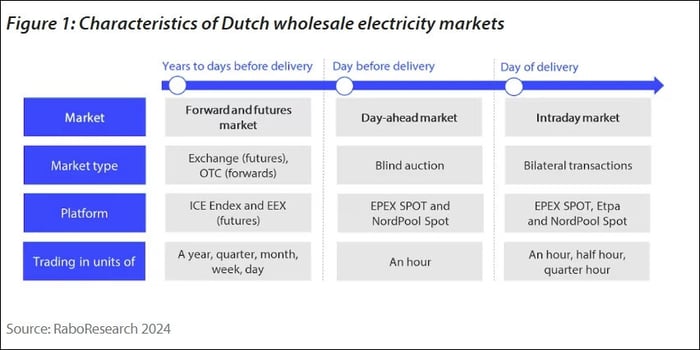
The Dutch wholesale market consists of three submarkets:
Forward and futures market
- For industry-scale suppliers and consumers
- Electricity is traded from 4 years to 1 month before delivery
- Forwards are non-standardized OTC (over-the-counter) products
- Futures are standardized exchange-traded products
Day-ahead market (spot market)
- Pan-European auction for buying and selling electricity in hourly products with next-day delivery
- Closes at 12:00 pm every day with pay-as-cleared pricing structure (all participants receive or pay the same price)
Intraday market (spot market)
- Pan-European auction for buying and selling electricity in hourly, half-hourly, and quarter-hourly products with same-day delivery
- Allows near real-time adjustments of order volumes as demand and supply scenarios manifest
- Closes 5 minutes before delivery with pay-as-bid pricing structure
Ancillary services
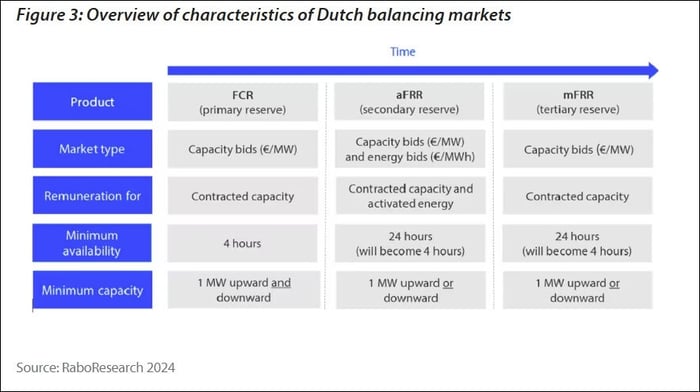
Ancillary services in the Netherlands comprise the balancing markets FCR, aFRR, and mFRR15- as well as the imbalance and congestion markets.
 Source: Rabobank
FCR (Frequency Containment Reserve)
- Primary regulation for grid disturbances
- Requires TenneT to have FCR capacity available at all times in both up- and downward directions (the exact amount depends on the minimum reference incident and a probabilistic dimensioning analysis)
- Procured in daily auctions with four hourly blocks
aFRR (automatic Frequency Restoration Reserve)
- Secondary regulation for grid disturbances
- Intended exclusively for real-time imbalance corrections
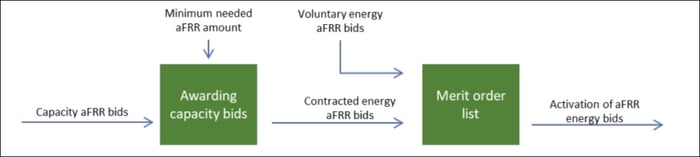
- Procured in capacity contracts as well as weekly and daily tenders
- Capacity contracts obligated to bid into energy; prioritized in the merit order
- Energy bids can be placed without capacity contracts
 Source: TenneT
Since September 2025, dynamic dimensioning has been in place. This means volumes are set daily based on current system conditions. The process includes a preliminary gate at D-5, a firm gate opening at 06:00 on D-1, and gate closure at 09:00. In November 2025, TenneT introduced 4-hour contracts, initially covering 10% of volumes, with the remainder still in 24-hour blocks. Both auctions run in parallel with the same gate closure, but indivisible bids are not allowed for 4-hour products. TenneT plans to move to 100% 4-hour procurement within 12 months, adjusting volumes monthly.
mFRR (manual Frequency Restoration Reserve)
- Tertiary regulation for grid disturbances
- Asymmetric capacity bids (either up or down)
- Procured in capacity contracts as well as weekly and daily tenders
- Capacity bids are 1 MW and up
- Historically provided by conventional generation due to reserve requirements
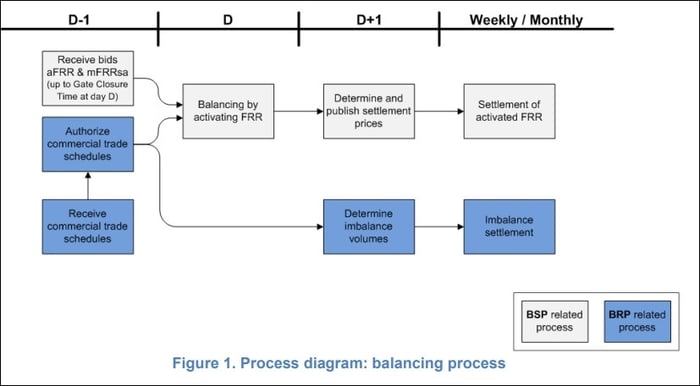
Imbalance market
- Addresses deviations between forecasted and actual energy consumption or production.
- Participants buy or sell electricity to correct mismatches in real-time.
- BRPs (Balancing Responsible Parties) financially settle imbalances in 15-minute blocks.
- Enables active positioning based on expected imbalance prices.
- The imbalance price is determined by the highest activated bid for upward and the lowest activated bid for downward capacity.
- Dual pricing possible: Positive and negative prices exist within one settlement period (unique to imbalance market).
 Source: TenneT
Congestion market
- Manages grid congestion via the GOPACS platform when electricity demand surpasses what the grid can supply.
- Financial incentives are given for optimized or reduced energy use. Assets receive a premium on top of intraday trades.
- Curtailments primarily affect solar and wind.
- Cross-border transmissions are utilized to relieve congested grid points.
Capacity market
At the time of writing, the Netherlands doesn't have a centralized capacity market but is evaluating the introduction of one to support post-2030 grid stability. By then, the coal phaseout is expected to reach completion, and renewable penetration will have advanced further, placing additional strain on the Dutch grid.
Impact of PICASSO on the Dutch power market
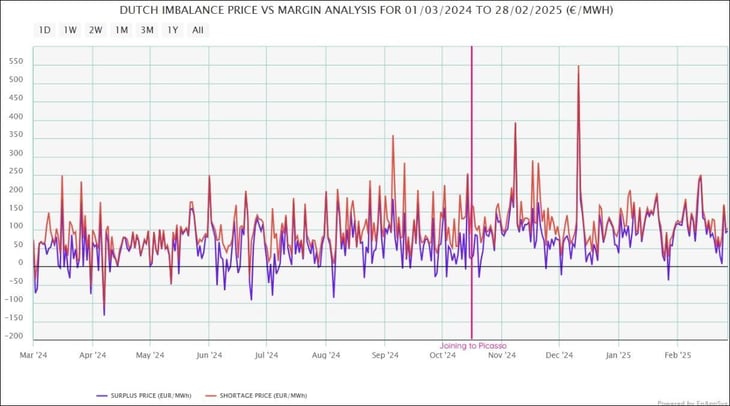
The Netherlands joined PICASSO, Europe’s cross-border balancing platform for aFRR, in October 2024. Following this, the Dutch energy market saw a significant reduction in imbalance price volatility and a decrease in peak imbalance prices. However, imbalance prices can be amplified if both the Netherlands and neighboring countries are facing energy shortages. In the chart below, you can see an occurrence of this linked to Dunkelflaute events between 11-12 December, 2024.
 Source: EnAppSys
Additionally, since aFRR bids were priced lower than in neighboring countries, the Dutch market recorded an increase in aFRR bid activations. For BESS, the rise in activations creates an opportunity for more sophisticated revenue diversification strategies, the need for which is becoming increasingly evident as PICASSO’s full impact on the Netherlands continues to unfold.
First 4-hour BESS project live in the Netherlands
The Netherlands is an emerging market for battery storage but, due to the lack of saturation, also a highly exploitable one. In early 2025, enspired, together with Flexcity and S4 Energy, reached an exciting milestone by taking the country’s first 4-hour BESS live in a cross-market optimization setup. The 10 MW battery is located in the Rilland municipality of Zeeland, and owner S4 Energy was looking for a partner that could transparently enable the asset’s market participation on a fully merchant basis across all revenue streams. enspired’s platform ticked all those boxes, and local player Flexcity contributes key expertise in market knowledge, ancillary services, and congestion management.
Outlook for BESS
The Netherlands is currently considered one of the most attractive markets for BESS investment, driven by strong price volatility and access to multiple revenue streams. High renewable penetration, particularly solar, leads to frequent periods of low prices, while a system still reliant on thermal generation drives high prices during scarcity periods. This combination creates significant opportunities for energy arbitrage.
In addition, the Netherlands stands out due to the transparency and liquidity of its imbalance mechanism. The availability of timely system signals enables BESS operators to actively position based on expected imbalance prices, making imbalance a core value driver rather than a residual cost. Further value can be captured through local congestion management. Combined with access to established ancillary service markets, this creates a diversified and attractive revenue stack for BESS assets in the Netherlands.
Sources:
Rabobank
TenneT
Taiyang News
Rap - Regulatory Assistance Project
CBS
Archived interview
We spoke with Dominique Becker, S4 Energy's Chief Commercial Officer (at the time of writing in April 2025), about the project and leveraging the full spectrum of the Dutch power market*.
*Please note that interview answers were shortened and refined for linguistic fluency and clarity where necessary.
What makes the Netherlands an interesting market for battery projects?
There is a cocktail of things that make that happen. For instance, the TSO is very aware of the fact that flexible assets like batteries are of great added value. We have a huge mix of renewables coming in, both from land and sea with wind and solar, and we have a very open market structure that enables flexibility to utilize the upside to the fullest.
Why is now the right time to invest in energy storage in the Netherlands?
Because you are ahead of the market and have that first mover advantage that allows you to make the very most of the flexible assets you deploy. Grid operators and energy markets need the services BESS can offer. The reason why we are going in with the 4-hour battery storage right now is because we envisage that there is going to be a market shift where we change from ancillary services to a full-stack energy market in a few years’ time. And we want to be ready to capture every moment and every upside of it.
How did Picasso reshape the power markets in the Netherlands?
In Q1 of 2025, that is too early to tell, but what we can already see happening is some dampening in the volatility of the markets. Grid providers are dealing with imbalances directly, and taking that volatility out of the market gives it a little bit of a downside effect.
What are the key success factors for a battery project in the Netherlands in 2025?
In my opinion, those would be the obvious three: land, permit, grid connection. But also: knowledge of the markets and access to capital. If you have those five in place, you have a successful project.