Poland’s electricity generation is dominated by coal, although the total share has been declining over the past decade – a trend expected to continue and intensify. In 2024, coal power production dropped to a record 56%, down 6% from the previous year, with a complete phaseout projected by 2040. Meanwhile, renewable sources are on the rise, accounting for a record 29% of generation in 2024. As of early 2026, renewables make up close to half of Poland’s installed capacity, and offshore wind projects will be among the biggest drivers of renewable penetration, with 6 GW expected by 2030 and 11 GW by 2040. Additions in nuclear generation are also part of the roadmap, with Poland planning for half of its total installed capacity to come from zero-emission sources by the same year.
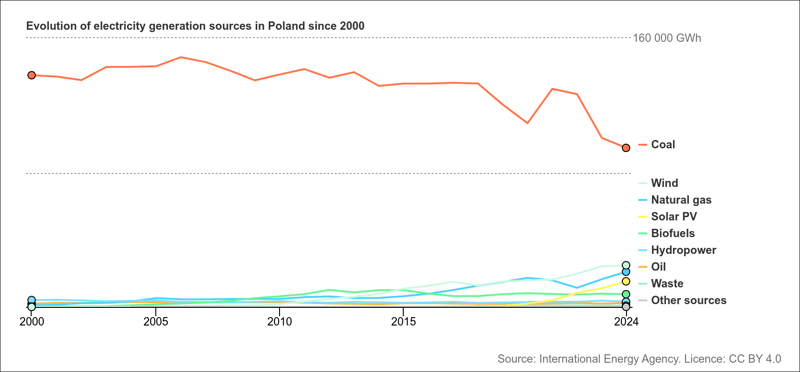 Electricity generation Poland | Source: IEA
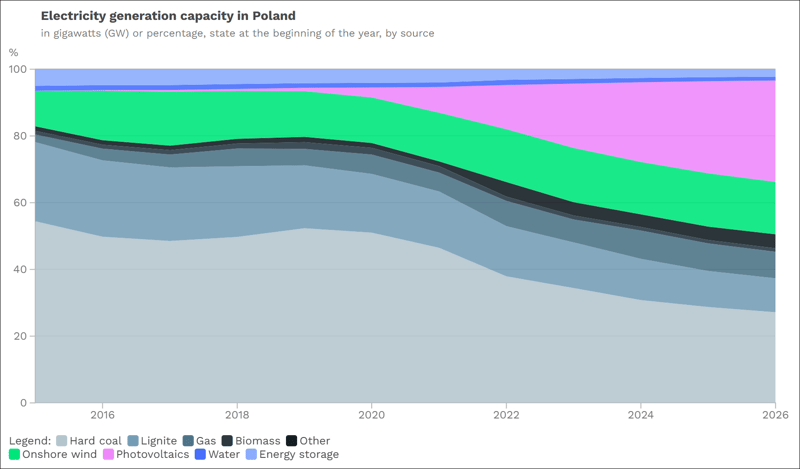 Electricity generation capacity Poland | Source: Energy Instrat & ENTSO-E
The Polish grid
Poland’s high-voltage transmission grid is state-owned and operated by Polskie Sieci Elektroenergetyczne S.A. (PSE). Medium- and low-voltage grids are scattered across the country and managed by regional Distribution System Operators (DSOs).
According to IEA, Poland had a maximum technical interconnection capacity of 11.8 GW in 2020, which has remained largely unchanged since, although a slight increase to 12.05 GW is planned for implementation by 2030. Current interconnections include 10 high-voltage AC (alternating current) lines with the Czech Republic, Germany, Slovakia, and Ukraine, as well as DC (direct current) lines with Sweden and Lithuania. The planned extension is for an undersea DC cable to Lithuania. On the whole, almost half of the EU’s grid infrastructure is aging, with many overhead lines over 40 years old and in need of modernization.
In August 2025, Poland introduced reforms to simplify and streamline grid connection procedures to deal with congestion. The changes aim to speed up administrative processes to accommodate the increase in grid access applications. All grid users in Poland pay grid fees. While BESS and other forms of storage don’t have a full exemption, regulatory reforms prohibit double payments for charging and discharging.
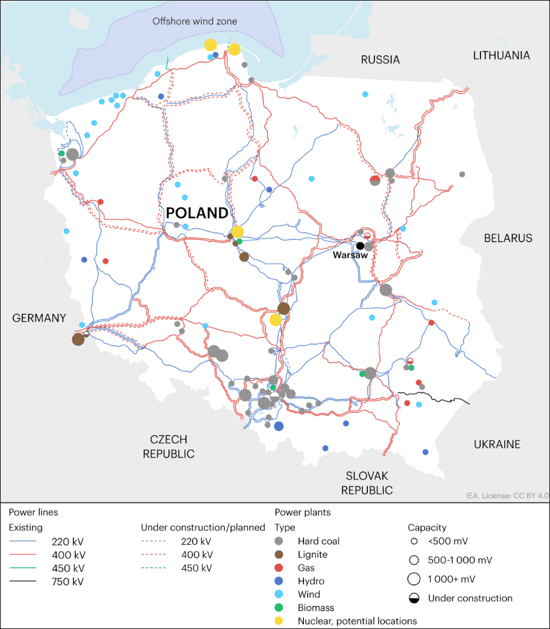 Poland's electricity grid system | Source: IEA
Power market overview Poland
Poland’s commercial environment for BESS and other power assets comprises several markets, submarkets, and revenue streams, including the ancillary services (open since June 2024), wholesale, imbalance, and capacity markets. Below are detailed overviews of all market segments.
Ancillary services (AS) in Poland
Ancillary services are a relatively nascent market in Poland, offering valuable revenue opportunities for early entrants. BESS projects should be dimensioned at a minimum of 2 MW to exceed the minimum AS bid size of 1 MW. Project sizes of 5 MW or more allow for flexible cross-market optimization. Ancillary services in Poland include:
- Primary response: FCR (Frequency Containment Reserve)
- Secondary response: aFRR (automatic Frequency Restoration Reserve)
- Tertiary response: mFRR (manual Frequency Restoration Reserve)
| FCR | aFRR | mFRR | |
| Common internal market | FCR Cooperation | PICASSO | MARI |
| National obligation | ~170–177 MW in each direction | ~500 MW in each direction | ~50–300 MW in each direction |
| Activation + speed | Automatic, ≤30 sec | Automatic, ≤5 min | Manual, ≤12.5 min |
| Submarkets | Capacity | Capacity + energy | Capacity + energy |
| Symmetry | Symmetrical (linked up/downward bids with same volume in both directions) | Asymmetrical (separate up/downward bids) | Asymmetrical |
| Divisible bids | Yes | Yes | Yes |
aFRR and mFRR products in Poland
| aFRR capacity | aFRR energy | mFRR capacity | mFRR energy | |
| Block duration | Hourly (main auction); 15 minutes (supplementary) | 15 minutes | Hourly (main auction); 15 minutes (supplementary) | 15 minutes |
| Minimum bid size | 1 MW | 1 MW | 1 MW | 1 MW |
| Volume granularity | 1 MW | 1 MW | 1 MW | 1 MW |
| Price granularity (EUR) | 0.1/MWh | 0.1/MWh | 0.1/MWh | 0.1/MWh |
| Bid submission |
Portfolio: Unit schedules & supplementary auction: |
Mandatory bids: Updates every 15 min until 55 min before delivery |
Portfolio: Unit schedules & supplementary auction: |
Mandatory bids: Updates every 15 min until 55 min before delivery |
| Remuneration |
Pay-as-bid |
Pay-as-cleared |
Pay-as-bid |
Pay-as-cleared |
Wholesale market (WS) in Poland
Wholesale electricity trading in Poland takes place on several organized exchanges and over-the-counter (OTC) platforms accessible through the Polish Power Exchange (TGE S.A.), EPEX SPOT, and NordPool. The day-ahead and intraday markets are operated by TGE (Towarowa Giełda Energii) and cleared via the European platforms SDAC (Single Day-Ahead Coupling) and SIDC (Single Intraday Coupling), respectively. Trading within SIDC is carried out in two ways:
- Continuous mode matches bids covered by the SIDC mechanism in a simultaneous, iterative process within the available transmission capacity.
- Auction mode matches bids not covered by the SIDC mechanism in the intraday auction process, in which congestion rent is determined based on individual bidding zone prices.
| DA | ID 1 | ID 2 | ID 3 | IDC | |
| Market type | Daily auction | Daily auction | Daily auction | Daily auction | Continuous trading |
| Order entry/gate closure |
(1) D-1, 08:00-10:30 CET (2) D-1, 08:00-12:00 CET |
D-1, 15:00 CET Delivery: D, 0:00-24:00 CET |
D-1, 22:00 CET Delivery: D, 0:00-24:00 CET |
D, 10:00 CET Delivery: D, 12:00-24:00 CET |
24/7 with 60-minute contracts up until one hour before delivery |
| Product type |
1-hour, 15-min blocks |
1-hour, 30-min, 15-min blocks | 1-hour, 30-min, 15-min blocks | 1-hour, 30-min, 15-min blocks | 1-hour, 15-min blocks |
| Remuneration |
Pay-as-cleared |
Pay-as-cleared | Pay-as-cleared | Pay-as-cleared | Pay-as-bid |
| Minimum bid (EUR) |
-500/MWh |
-500/MWh | -500/MWh | -500/MWh | -500/MWh |
| Maximum bid (EUR) |
4,000/MWh |
4,000/MWh | 4,000/MWh | 4,000/MWh | 4,000/MWh |
| Price increments (EUR) |
0.1/MWh |
0.1/MWh | 0.1/MWh | 0.1/MWh | 0.1 /MWh |
| Volume increments |
0.1 MW |
0.1 MW | 0.1 MW | 0.1 MW | 0.1 MW |
Balancing and imbalance markets
In Poland, balancing responsibility is mandatory for all BRPs (Balancing Responsible Parties; in Polish: Podmiot Odpowiedzialny za Bilansowanie Handlowe, POB). The national balancing market is operated by PSE with 15-minute settlement periods. In the balancing market, PSE activates energy reserves procured as balancing services (FCR, aFRR, mFRR) in the ancillary service market to maintain grid balance. These activations are then financially settled in the imbalance market.
New TCMs (Terms, Conditions, and Methodologies of Electricity Balancing) came into force in Poland in June 2024, impacting the operation of market participants and creating new business opportunities for BESS. Before the shift, BRP and BSP (Balancing Service Providers; in Polish: Dostawca Usług Bilansujących, DUB) roles weren’t formally separated, while now they’re individual carveouts, each with dedicated areas of responsibility.
Capacity market
The Polish capacity market is a support mechanism that ensures security of supply by paying generators and demand response providers for making capacity available during system stress. It operates on a yearly and quarterly delivery basis and has been operational since 2018. Between 2018-2022, PSE awarded capacity contracts mainly to conventional installations, while large-scale battery storage facilities began receiving them in December 2022. The first go-lives for batteries under this scheme are expected in 2027.
A CAPEX support scheme offers substantial grant funding alongside preferential loans to accelerate the deployment of utility-scale BESS in Poland. The program has garnered strong developer interest, was heavily oversubscribed, and requires supported projects to be delivered by 2028.
BESS buildout and expected market developments
Between 2026 and 2030, Poland’s ancillary service market will expand rapidly as electrification and renewable penetration push peak demand and associated balancing needs. To address the increase in system volatility, the supply roadmap is shifting toward fast-response flexibility from storage and demand-side response facilities, with nearly 2 GW of BESS expected to be deployed by 2028. National support schemes worth approximately €1 billion, grid investments, and EU market integrations are facilitating Poland’s transition away from coal-based balancing toward a more efficient, climate-friendly, and future-proof energy system.
Outlook for BESS
Financing is a common pain point in BESS development, and banks in Poland typically require a form of revenue guarantee – for example, (partial) tolls – to give assurance. Batteries are expected to reach their full revenue potential within a year of EON (Energization Operational Notification) in the Polish structure.
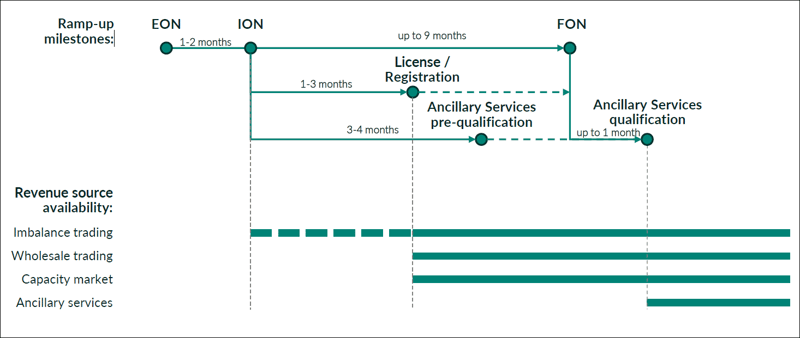 Source: Ekovoltis
According to recent findings by Aurora Energy Research, batteries in Poland would have generated some of the strongest revenues in Europe if they had competed in the market between June 2024 and September 2025. The Polish balancing reform and high-reward ancillary service participation are cited among the main reasons for this, with arbitrage revenues on the rise, partially reflecting the impact of PICASSO on aFRR energy prices.
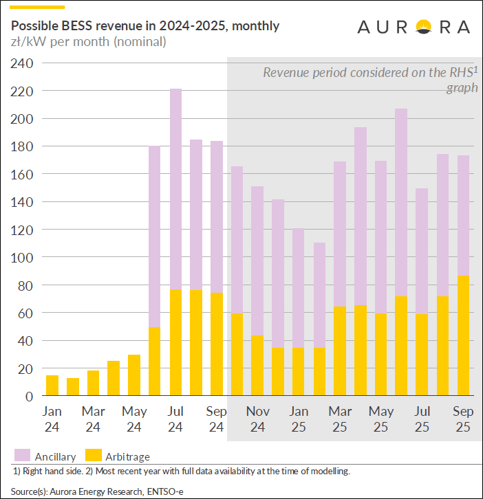 Source: Aurora Energy Research
The liberalization of the AS market is the main revenue driver for BESS in Poland, exhibiting elevated prices and low saturation. However, since limited depth will eventually make this market prone to cannibalization, time-to-market is critical. Secondary revenue boosters include project size and grid location, as these determine competition and activation frequency.
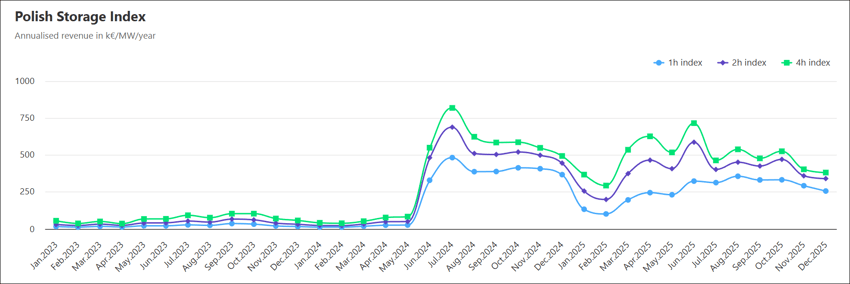 Source: Clean Horizon
Clean Horizon’s storage index for Poland reflects this analysis, displaying a steep upward curve in battery revenues following the introduction of ancillary services. Since then, revenue trends have remained stable and predictable, mirroring seasonal market shifts and highlighting the growing value of fast-acting flexibility.
Disclaimer: The header visual was generated using AI.
Sources:
IEA
Our World in Data
PSE
CMS LawNow
Ember
Energy Policy of the Republic of Poland
European Court of Auditors
Clean Horizon Battery Index
Financial Times
Energy Instrat, ENTSO-E
Battlink
PV Magazine
Ekovoltis
Aurora Energy Research